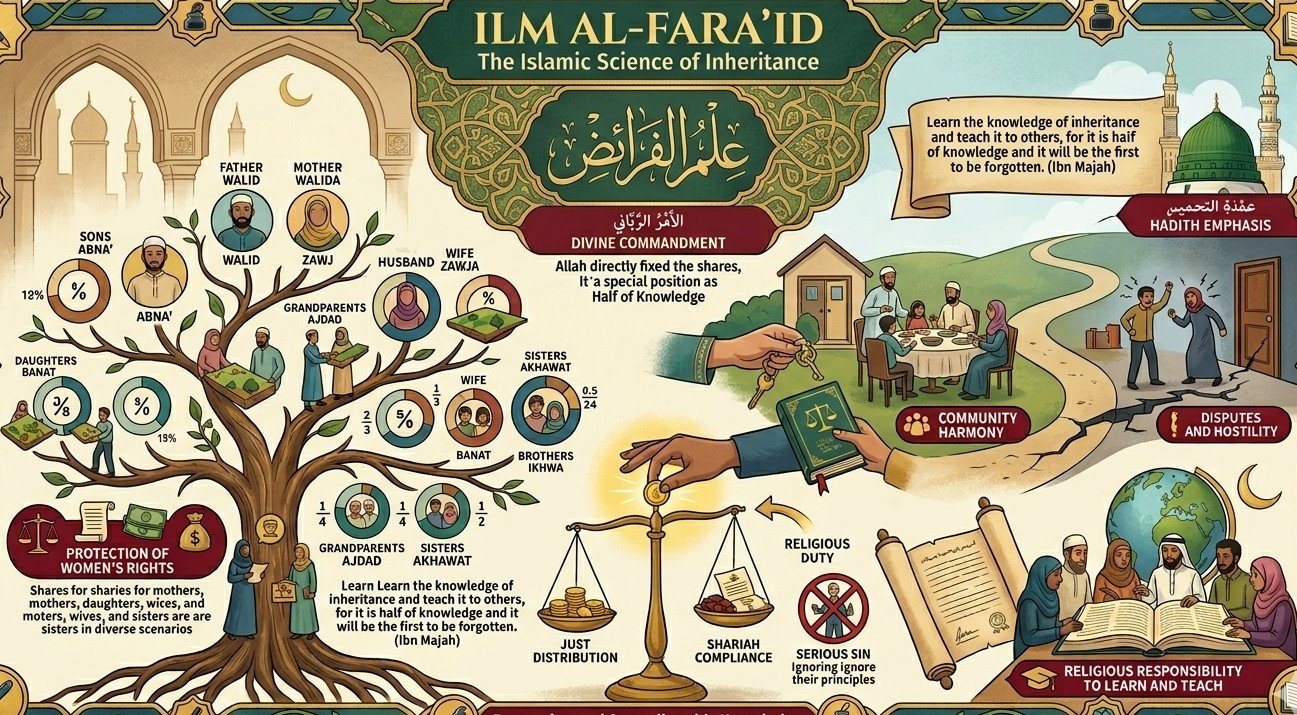
Islam is a complete code of life that provides guidance for every aspect of human existence From acts of worship to social matters economy politics and inheritance Islam has established clear and just principles Among these principles one of the most important and sensitive subjects is the knowledge of inheritance which in Islamic jurisprudence is known as Ilm al Faraid
In the Holy Quran the laws of inheritance are explained in great detail especially in Surah An Nisa This is the only field in Islam in which the shares and proportions have been directly fixed by Allah Himself The rights of parents children husband wife brothers sisters and even in certain cases grandparents and other relatives have been clearly defined in Shariah This detailed explanation is proof that the knowledge of inheritance holds a special position in Islamic law
Religious Obligation to Learn and Spread the Knowledge of Inheritance
The Messenger of Allah peace be upon him emphasized the importance of this knowledge by saying Learn the knowledge of inheritance and teach it to others because it is half of knowledge and it will be the first to be forgotten Ibn Majah
This hadith highlights that preserving and spreading this knowledge in the Muslim community is a religious responsibility Unfortunately in today time many people are unaware of the rules of inheritance As a result injustice in the distribution of property and family disputes arise Sometimes these conflicts turn into permanent hostility within families and continue for generations
Protection of Women’s Rights and Social Justice Through the Law of Inheritance
Another important benefit of the knowledge of inheritance is that it protects the rights of weaker members of society especially women Islam granted women a share in inheritance and strengthened their financial position which was not recognized in many earlier civilizations Mothers daughters wives and sisters were given fixed shares in Shariah sending a clear message that Islam stands for justice and fairness
The knowledge of inheritance is not only a branch of jurisprudence but also a social obligation After the death of a person the distribution of his estate according to Shariah is not merely a legal requirement but also a religious duty Whoever ignores these principles or deliberately deprives an heir of their rightful share commits a serious sin
Today every Muslim should learn this knowledge teach it to others and act upon it